Monsoon Masonry Guide
Monsoon Block Wall Damage in Phoenix: How to Tell If Your Wall Needs Repair or Replacement
By Tera’s Masonry — ROC #336857 | Serving Phoenix, Scottsdale, Gilbert, Chandler, Mesa, Goodyear and the greater Valley.
Get a Free QuoteYou wake up the morning after a Phoenix monsoon, walk into the backyard, and see the block wall between you and your neighbor leaning three inches out of plumb. Maybe a whole section is on the ground. Maybe there’s a stair-step crack climbing from the footing to the cap, or the pilaster next to the gate has separated from the run.
It’s a scene we see every August across the Valley — from Ahwatukee to North Scottsdale, from Gilbert to Goodyear. The good news: most Phoenix block walls that get roughed up by a monsoon can be repaired without a full tear-out. The bad news: a lot of walls get “patched” by unlicensed crews in a way that fails again the next storm, or worse, hides the real structural problem underneath.
This guide walks you through what actually happened to your wall, what a legitimate repair looks like, and how to decide when replacement is smarter than repair. You can also explore our full masonry capabilities on our services page.
Why Phoenix Block Walls Fail in Monsoon Season
Monsoon storms do not damage healthy, well-built block walls very often. When a wall comes down or leans, it is almost always because a pre-existing weakness finally met a big enough weather event.
Saturated Soil Around the FootingA 1–2 inch monsoon dump can push the soil around an older footing into a semi-liquid state. Walls with shallow or undersized footings tip because the ground loses its grip.
Straight-Line Winds and MicroburstsPhoenix monsoons regularly produce 60–80 mph gusts. A tall, unreinforced perimeter wall acts like a sail when it does not have adequate rebar and grouted cells.
Aged Mortar JointsWalls built in the 1980s and 90s often have mortar that has weathered down below the block face. Water gets in, and UV exposure continues the breakdown.
Poor Drainage Against the WallIf your yard slopes toward the wall, or an HOA drainage swale dumps runoff along its base, the wall may be fighting hydrostatic pressure it was never designed for.
Roots and SettlementMesquite, palm, and ficus roots can lift footings quietly for years. One strong monsoon can expose movement that was already happening underground.
Old Repairs That Hid the ProblemSurface patches, mismatched mortar, and unsupported rebuilt sections often look acceptable for a while, but they do not correct the footing or reinforcement issue.
Failure Mode Diagnostic: What Are You Actually Looking At?
Use the table below to identify what you are seeing. Snap a few photos before you touch anything — you will want them for your insurance carrier and for the mason you bring out to quote the work.
| What You See | Likely Cause | Typical Fix |
|---|---|---|
| Wall leaning 1–4 inches out of plumb, still standing | Saturated soil plus wind load; footing may be intact | Brace and reset if minor; partial rebuild with new rebar and grout if severe |
| Stair-step crack running diagonally through mortar joints | Foundation settlement or footing movement | Investigate footing; tuckpoint if cosmetic, rebuild affected section if structural |
| Horizontal crack across the middle of the wall | Lateral wind load exceeded the wall’s reinforcement | Section rebuild with properly grouted, rebar-reinforced cells |
| Blown-out or missing caps | Wind uplift; cap mortar failed | Re-cap with matching block and proper mortar bed |
| Pilaster or column separated from wall run | Inadequate tie-in between column and run | Rebuild pilaster with proper reinforcement and bond to adjacent block |
| Full section collapsed to the ground | Combination of soil saturation, wind, and undersized footing or rebar | Full section rebuild, often with a new footing |
| Efflorescence with hairline cracks | Water intrusion through joints, usually no structural issue yet | Tuckpoint and seal; monitor the wall after future storms |
A leaning wall is not just a cosmetic issue. Any wall that is visibly out of plumb should be inspected before kids, pets, or neighbors spend time near it.
Repair vs. Replace: How to Decide
There is no single rule, but this is the honest framework a licensed mason will use when walking your property.
Repair Is Usually the Right Call When:
- Damage is confined to one section or one pilaster.
- The footing is intact and level.
- The rest of the wall is plumb, sound, and less than about 30 years old.
- Block color and size are still available, or the repair can be blended with stucco or paint.
Replacement Is Usually Smarter When:
- The wall is leaning along most of its length, not just at the damage point.
- The footing has failed or was never sized for the wall height.
- Multiple sections have already been patched over the years.
- The wall is over 6 feet tall and was built without engineered reinforcement.
- You are adding a pool, spa, or hardscape that will change loads on the wall.
Any wall over 6 feet, or any wall serving as a retaining function, will almost always require an engineered design when it is rebuilt.
Shared and HOA Walls: Who Pays and How to Handle It
A huge percentage of Phoenix perimeter walls are shared between two homeowners or sit on the property line of an HOA-governed community. When a shared wall comes down, the situation can get political fast.
- Arizona is generally a shared-responsibility state for boundary walls, so both owners typically share the cost of repair on a wall that sits on the property line.
- Check your HOA CC&Rs before committing to a color, block type, or finish.
- Get the repair quote in writing and share it with your neighbor before work starts.
- If the wall borders a common area, drainage easement, greenbelt, or community amenity, the HOA is usually responsible for that side.
- Homeowner’s insurance may cover storm damage to a wall, but coverage is inconsistent, so read your policy before assuming reimbursement.
What a Proper Block Wall Repair Actually Includes
Here is the difference between a quick patch that fails and a real repair that lasts. When we quote a monsoon repair, this is what belongs in the scope:
- Footing inspection: Before rebuilding anything, the existing footing should be exposed and verified.
- Rebar continuity: New block courses should receive vertical rebar tied into the existing wall and footing, with grouted cells at the required spacing.
- Block matching: The new block should match the original in size, texture, and color as closely as possible.
- Color-matched mortar: Standard gray mortar against a warm-tone wall looks like a bandage. Custom color matching is often worth it.
- Cap replacement: Damaged caps should be replaced with a proper mortar bed and, where appropriate, fastening to resist future uplift.
- Drainage correction: If runoff or soil saturation contributed to failure, rebuilding without addressing the cause is throwing money at the same problem.
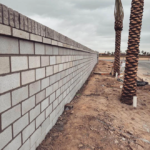
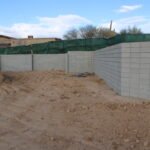
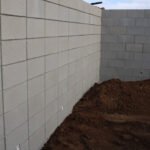
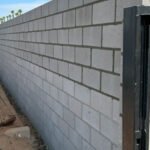
You can view examples of completed masonry work in our project gallery.
Permits, Codes and Insurance Notes for Phoenix
Repair work on residential block walls in the City of Phoenix and most Valley municipalities typically does not require a standalone permit if you are patching in kind and the wall is under 6 feet. Once you cross certain lines, you are usually in permit territory.
- Full rebuild of a wall section, not just tuckpointing or replacing a few blocks.
- Any wall over 6 feet in exposed height.
- Any wall performing a retaining function by holding back grade.
- Walls in floodplain overlay zones or specific overlay districts.
On the insurance side, document everything before repair starts. Take time-stamped photos, request the mason’s written scope of work, and keep the ROC license number of the contractor performing the work.
How to Vet a Mason After a Monsoon
Storm chasers show up in the Valley every August. They knock doors, offer cash-only deals, and disappear before the next season.
- Verify the ROC license at azroc.gov. A licensed masonry contractor in Arizona carries a specific classification, such as CR-11 or K-11.
- Confirm the contractor is bonded and carries current liability insurance.
- Get a written scope, not a napkin quote.
- Ask how they handle footing inspection and rebar continuity.
- Check for Google reviews that mention wall repair specifically.
Tera’s Masonry has been building and repairing Valley block walls for multiple generations under ROC #336857.
Frequently Asked Questions
How much does block wall repair cost in Phoenix?
A small tuckpointing or single-section repair typically runs $400–$1,200. A full pilaster rebuild or 10–15 linear feet of wall replacement usually falls in the $1,800–$4,500 range.
Can you match my existing block?
Usually yes. Standard 8x8x16 gray or slump block is still widely available. Discontinued colors or specialty finishes are harder.
Will my HOA approve the repair?
Most HOAs have a straightforward architectural review process for like-for-like repairs. Submit the mason’s scope and a photo of the block or finish being used.
Is my leaning wall going to fall?
Any wall leaning more than 2 inches out of plumb per 6 feet of height should be considered a life-safety concern until inspected.
Do you handle shared walls with my neighbor?
Yes. We can coordinate a single quote that both property owners can review and sign off on, and we can invoice each side separately if needed.
How long does a typical repair take?
A single-section repair is usually a 1–2 day job on site, plus cure time before final finishing. Larger rebuilds with new footings often run 3–5 days.
Should I wait until monsoon season is over?
For structural repairs — leaning, cracked, or collapsed walls — do not wait. Cosmetic work like tuckpointing or refinishing can safely wait until fall.
For more common questions about masonry repairs, materials, and project planning, visit our FAQ page.
Get a Free On-Site Quote
If your Phoenix, Scottsdale, Gilbert, Chandler, or Mesa block wall took damage in a monsoon, do not wait for the next storm to make the decision for you.
Tera’s Masonry offers free, no-obligation on-site quotes throughout the Valley. ROC #336857 | Licensed, bonded and insured across the greater Phoenix Valley.
Schedule Your Free QuoteExplore Services